
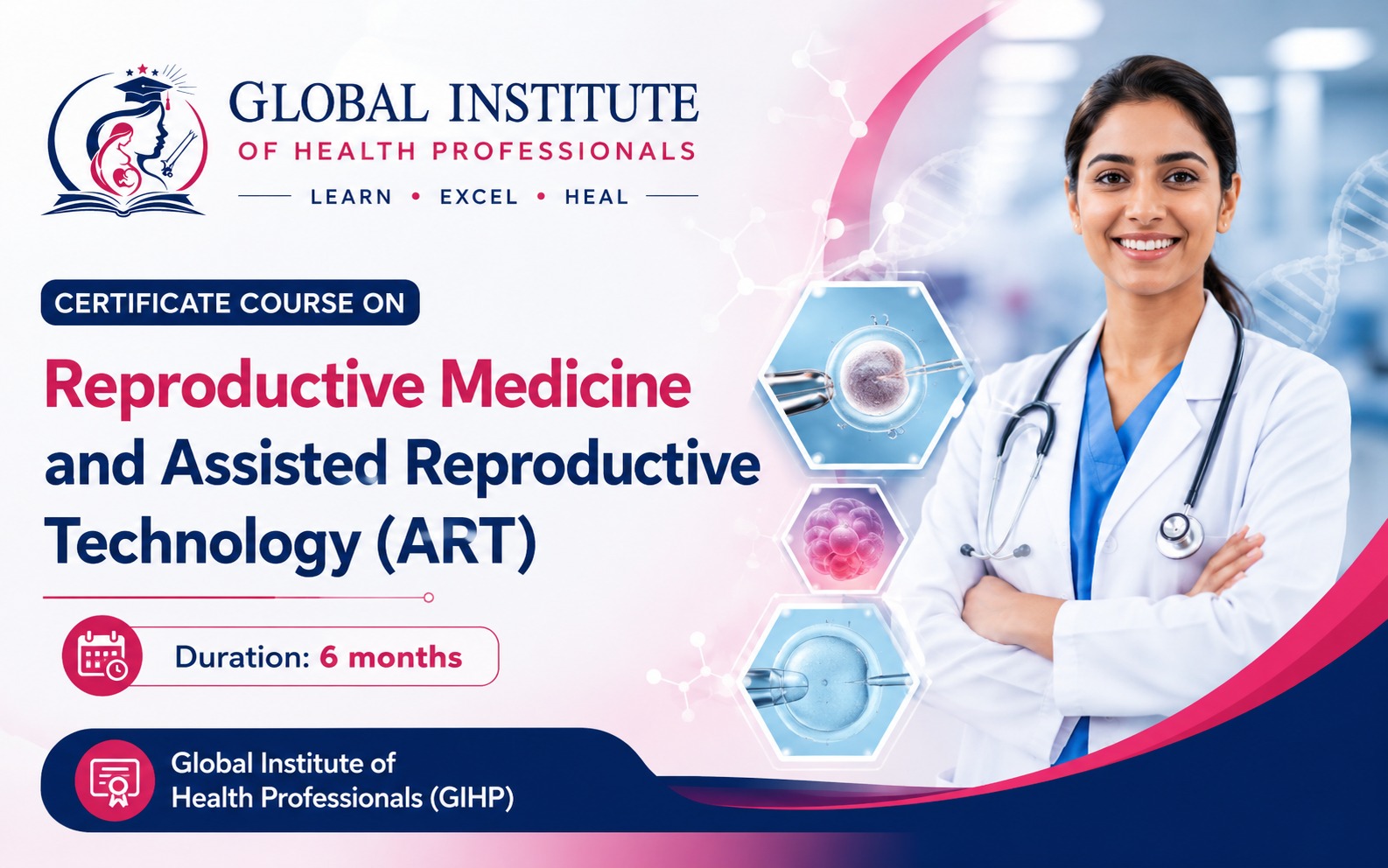
The Certificate Course on Reproductive Medicine and Assisted Reproductive Technology (ART) is a specialized 6-month professional program designed to provide comprehensive knowledge of reproductive physiology, infertility diagnosis and management, assisted reproductive technologies, fertility preservation, ART laboratory practices, and research methodology.
Applicants with the following qualifications may apply:
Class Schedule
Saturday | Tuesday | Thursday
45 Minutes × 3
Module 1: Reproductive Physiology, Developmental Defects, Genetics & Endocrinology
Topics Covered
Learning Outcomes
At the end of this module, students will be able to:
Teaching & Learning:
Lecture, guided discussion, video demonstration and hands-on practical.
Assessment:
MCQ + SAQ
Module 2: Gametogenesis to Implantation
Topics Covered
Learning Outcomes
At the end of this module, students will be able to:
Teaching & Learning:
Lecture, guided discussion, video demonstration and hands-on practical.
Assessment:
MCQ + SAQ
Module 3: Infertility Diagnosis & Management
Topics Covered
Learning Outcomes
At the end of this module, students will be able to:
Teaching & Learning:
Lecture, guided discussion, video demonstration and hands-on practical.
Assessment:
MCQ + SAQ
Module 4: Assisted Reproductive Technologies (ART)
Topics Covered
Learning Outcomes
At the end of this module, students will be able to:
Teaching & Learning:
Lecture, guided discussion, video demonstration and hands-on practical.
Assessment:
MCQ + SAQ
Module 5: Research Methodology
Topics Covered
Learning Outcomes
At the end of this module, students will be able to:
Teaching & Learning:
Research-oriented academic guidance and supervised dissertation development.
Assessment:
Dissertation evaluation
Module 6: Final Evaluation
A comprehensive evaluation will be conducted after completion of the course.
Assessment Components
Passing Criteria
Minimum Pass Score: 60%
| Score | Result |
|---|---|
| 60%–69% | Satisfactory |
| 70%–79% | Highly Satisfactory |
| 80% and above | Distinction |
The course combines theoretical knowledge with practical and clinically oriented learning through: