

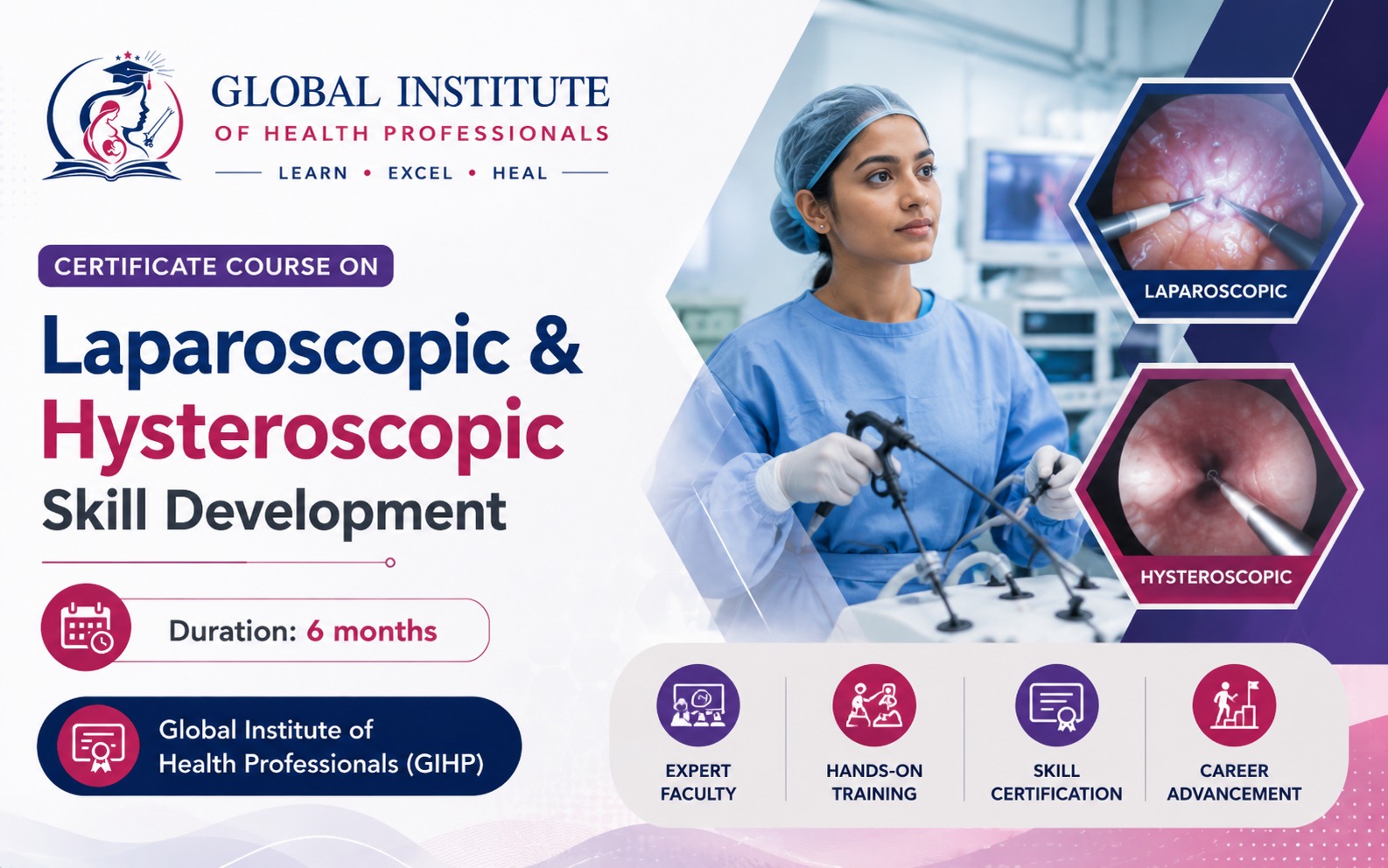
Certificate course on Laparoscopic & Hysteroscopic Skill Development

  • Home
  • Courses
  • Certificate course on Laparoscopic & Hysteroscopic Skill Development
Certificate course on Laparoscopic & Hysteroscopic Skill Development

Certificate course on Laparoscopic & Hysteroscopic Skill Development

The Certificate Course on Laparoscopic & Hysteroscopic Skill Development is designed to provide structured theoretical and practical training in laparoscopic and hysteroscopic procedures, including instruments, operating room setup, surgical ergonomics, access techniques, suturing, endo-trainer practice, and diagnostic and operative hysteroscopy. The course will be conducted by Global Institute of Health Professionals (GIHP) in collaboration with the Department of Public Health and Informatics at Jahangirnagar University (DPHI-JU), Dhaka, Bangladesh.

  • Duration: 6 Months
  • Program Type: Certificate Course
  • Teaching: Theory + Practical Training
  • Practical Exposure: Embryology & ART Laboratory Skills
  • Assessment: MCQ, SAQ, Practical
  • Final Passing Score: 60% or higher
  • Classes: Saturday, Tuesday & Thursday
  • Session: 45 minutes × 3
  • Academic Collaboration: DPHI, Jahangirnagar University

Applicants with the following qualifications may apply:

  • MBBS
  • FCPS
  • DGO
  • MS

Class Schedule

Classes will be held on:

Saturday, Tuesday & Thursday

45 minutes × 3 sessions

Course Learning Outcomes & Curriculum

The course consists of 18 modules, combining lectures, guided discussions, video demonstrations and hands-on practical training.

Module 1: Laparoscopic Instruments and Devices

Topics:

  • Identification of various laparoscopic instruments
  • Laparoscopic devices and their components
  • Appropriate use and proper handling of laparoscopic devices

Learning Outcomes:

At the end of this module, students will be able to:

  • Identify various laparoscopic instruments and devices.
  • Understand the components of laparoscopic equipment.
  • Demonstrate appropriate use and proper handling of laparoscopic devices.

Teaching–Learning Strategy:

  • Lecture
  • Guided discussion
  • Video demonstration
  • Hands-on practical

Assessment:

  • Multiple Choice Questions (MCQ)
  • Short Answer Questions (SAQ)

Module 2: Cleaning & Sterilization of Instruments

Topics:

  • Principles of laparoscopic instrument sterilization
  • High-Level Disinfection (HLD)

Learning Outcomes:

Students will understand the principles and practices of laparoscopic instrument sterilization and high-level disinfection.

Teaching–Learning Strategy:

  • Lecture
  • Guided discussion
  • Video demonstration
  • Hands-on practical

Assessment:

  • MCQ
  • SAQ

Module 3: Energy Sources in Laparoscopic Surgery

Topics:

  • Basic principles of energy devices
  • Safe use of energy devices
  • Prevention of adverse effects and complications

Learning Outcomes:

Students will be able to:

  • Understand the basic principles of energy devices.
  • Apply safe practices when using energy devices.
  • Recognize and avoid adverse effects and complications.

Teaching–Learning Strategy:

  • Lecture
  • Guided discussion
  • Video demonstration
  • Hands-on practical

Assessment:

  • MCQ
  • SAQ

Module 4: Operating Room Setup & Ergonomic Adjustments

Topics:

  • Operating room setup principles
  • Ergonomic principles of laparoscopy

Learning Outcomes:

Students will be able to:

  • Understand appropriate operating room setup.
  • Apply basic ergonomic principles during laparoscopic procedures.

Teaching–Learning Strategy:

  • Lecture
  • Guided discussion
  • Video demonstration
  • Hands-on practical

Assessment:

  • MCQ
  • SAQ

Module 5: Laparoscopic Access & Port Placement

Topics:

  • Pneumoperitoneum creation
  • Extraperitoneal space creation
  • Port placement strategies
  • Troubleshooting

Learning Outcomes:

Students will be able to understand principles of laparoscopic access and port placement and identify potential access-related problems.

Teaching–Learning Strategy:

  • Lecture
  • Guided discussion
  • Video demonstration
  • Hands-on practical

Assessment:

  • MCQ
  • SAQ

Module 6: Laparoscopic Tissue Approximation – Knotting & Suturing

Topics:

  • Endosuturing
  • Extracorporeal and intracorporeal knotting
  • Clipping
  • Tacking
  • Stapling
  • Fibrin glue

Learning Outcomes:

Students will develop an understanding of laparoscopic tissue approximation techniques, including knotting, suturing and alternative tissue approximation methods.

Teaching–Learning Strategy:

  • Lecture
  • Guided discussion
  • Video demonstration
  • Hands-on practical

Assessment:

  • MCQ
  • SAQ

Module 7: Patient Positions & Associated Injuries

Topics:

  • Position-related injuries
  • Injuries associated with pneumoperitoneum
  • Procedural complications

Learning Outcomes:

Students will be able to:

  • Understand various position-related injuries.
  • Recognize injuries associated with pneumoperitoneum.
  • Identify potential procedural complications.

Teaching–Learning Strategy:

  • Lecture
  • Guided discussion
  • Video demonstration
  • Hands-on practical

Assessment:

  • MCQ
  • SAQ

Module 8: Mistakes & Errors in Laparoscopic Surgery

Topics:

  • Avoiding mishaps and near misses
  • Safe laparoscopic surgery

Learning Outcomes:

Students will be able to recognize potential errors and apply principles aimed at avoiding mishaps and near misses during laparoscopic surgery.

Teaching–Learning Strategy:

  • Lecture
  • Guided discussion
  • Video demonstration
  • Hands-on practical

Assessment:

  • MCQ
  • SAQ

Module 9: Practice for Laparoscopic Instruments & Devices

Topics:

  • Instrument identification
  • Instrument usability
  • Instrument assembly and organization
  • Instrument setup

Learning Outcomes:

Students will be able to:

  • Recognize correct and usable instruments.
  • Assemble and organize laparoscopic instrument setups.

Teaching–Learning Strategy:

  • Lecture
  • Guided discussion
  • Video demonstration
  • Hands-on practical

Assessment:

  • MCQ
  • SAQ

Module 10: Practice for Laparoscopic Ergonomics

Topics:

  • Optimization of the laparoscopic surgical environment
  • Reduction of musculoskeletal strain
  • Reduction of mental fatigue

Learning Outcomes:

Students will understand how to optimize the laparoscopic surgical environment while reducing physical strain and mental fatigue.

Teaching–Learning Strategy:

  • Lecture
  • Guided discussion
  • Video demonstration
  • Hands-on practical

Assessment:

  • MCQ
  • SAQ

Module 11: Practice for Laparoscopic Access

Topics:

  • Correct and optimum access
  • Prevention of underlying injuries
  • Prevention of access-related complications

Learning Outcomes:

Students will be able to understand appropriate laparoscopic access techniques and recognize methods for avoiding underlying injuries and complications.

Teaching–Learning Strategy:

  • Lecture
  • Guided discussion
  • Video demonstration
  • Hands-on practical

Assessment:

  • MCQ
  • SAQ

Module 12: Practice for Laparoscopic Endo-Trainer

Topics:

  • Hand-eye coordination
  • Depth perception
  • Instrument coordination

Learning Outcomes:

Students will be able to:

  • Improve hand-eye coordination.
  • Develop depth perception.
  • Improve laparoscopic instrument coordination.

Teaching–Learning Strategy:

  • Lecture
  • Guided discussion
  • Video demonstration
  • Hands-on practical

Assessment:

  • MCQ
  • SAQ

Module 13: Practice for Laparoscopic Endo-Suturing

Topics:

  • Extracorporeal knot creation
  • Intracorporeal knotting
  • Tissue suturing and repair
  • Handling of suture needles and needle holders

Learning Outcomes:

Students will be able to:

  • Create and secure extracorporeal knots.
  • Suture and repair tissue using intracorporeal knotting.
  • Properly handle suture needles and needle holders.

Teaching–Learning Strategy:

  • Lecture
  • Guided discussion
  • Video demonstration
  • Hands-on practical

Assessment:

  • MCQ
  • SAQ

Module 14: Practice for Laparoscopic Clipping, Tacking & Stapling

Topics:

  • Tissue approximation devices
  • Clipping
  • Tacking
  • Stapling
  • Safe tissue approximation

Learning Outcomes:

Students will be able to:

  • Understand basic principles of tissue approximation devices.
  • Apply appropriate techniques for securing tissues while minimizing injuries and complications.

Teaching–Learning Strategy:

  • Lecture
  • Guided discussion
  • Video demonstration
  • Hands-on practical

Assessment:

  • MCQ
  • SAQ

Module 15: Instruments & Room Setup for Hysteroscopy

Topics:

  • Media for distending the uterine cavity
  • Cold light source
  • Imaging systems
  • Endoscopes
  • Diagnostic hysteroscopes
  • Operative hysteroscopes
  • Resectoscopes
  • Electrosurgical units for high-frequency surgery
  • Hysteroscopic laser surgery
  • Office hysteroscopy preparation
  • Operating room setup
  • Instrument maintenance and sterilization

Learning Outcomes:

Students will develop knowledge of hysteroscopic instruments, equipment, operating room setup, maintenance and sterilization procedures.

Teaching–Learning Strategy:

  • Lecture
  • Guided discussion
  • Video demonstration
  • Hands-on practical

Assessment:

  • MCQ
  • SAQ

Module 16: Basic Principles of Diagnostic & Surgical Hysteroscopy

Topics:

  • Levels of technical complexity
  • Indications
  • Contraindications
  • Instrumentation
  • Preoperative preparation
  • Anesthesia
  • Distension media
  • Complications
  • Medical follow-up after hysteroscopy

Learning Outcomes:

Students will be able to understand the fundamental principles of diagnostic and surgical hysteroscopy, including patient preparation, instrumentation, indications, contraindications and potential complications.

Teaching–Learning Strategy:

  • Lecture
  • Guided discussion
  • Video demonstration
  • Hands-on practical

Assessment:

  • MCQ
  • SAQ

Module 17: Research Methodology

Topics:

  • Study population vs. study sample
  • Study design
  • Sampling techniques
  • Sample size calculation
  • Inclusion and exclusion criteria

Learning Outcomes:

Students will develop an understanding of fundamental research methodology and study design concepts.

Academic Requirement:

  • Writing and submitting a dissertation
  • Dissertation evaluation

Module 18: Final Evaluation

Evaluation Structure:

  • Evaluation test after every module
  • Efficiency test at the end of the course
  • Written examination
  • OSPE
  • Viva Voce

Pass Score: 60% or higher

Grading:

  • 60%–69%: Satisfactory
  • 70%–79%: Highly Satisfactory
  • 80% and above: Distinction

The course uses a combination of:

  • 📚 Lectures
  • 💬 Guided discussions
  • 🎥 Video demonstrations
  • 🩺 Hands-on practical training
  • 🔬 Skills-based practice
  • 📝 Module-based assessments
  • 🎓 Dissertation work
  • 📋 Final written, OSPE and Viva Voce evaluation

Live Support